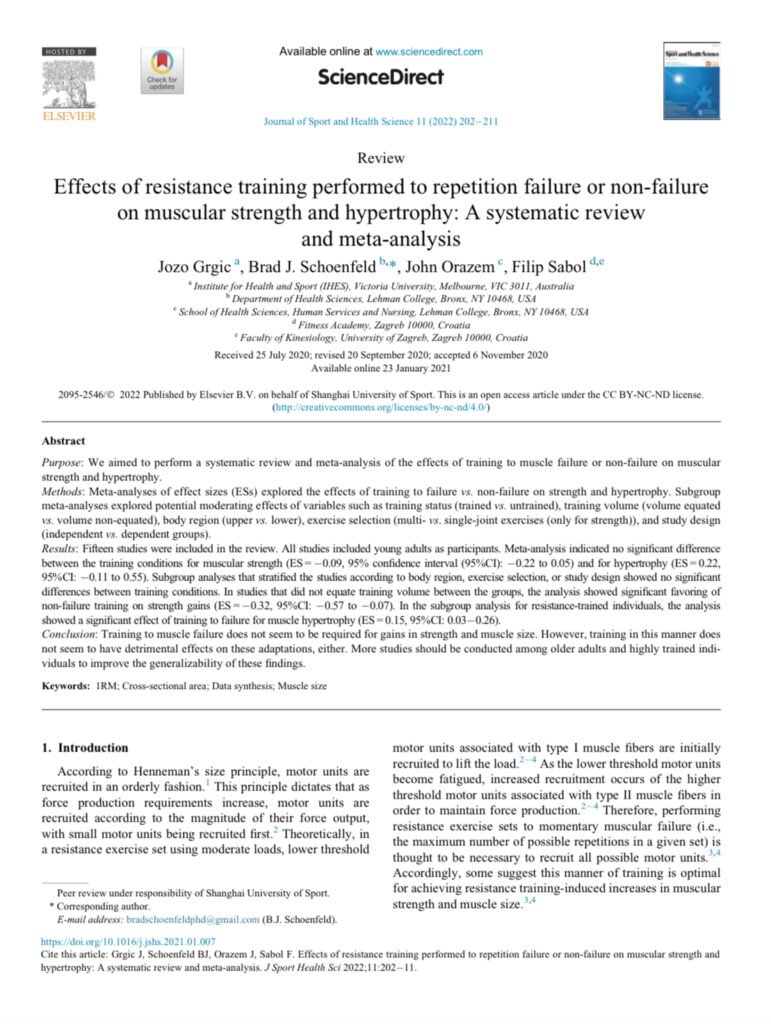
It seems that training to failure and not training to failure result in a similar amount of muscle mass.
Perhaps it might be a good idea to occasionally train to failure in smaller muscle groups that don’t generate as much fatigue, and perhaps in exercises that generate a lot of fatigue, with a good reason and a bit more caution to avoid putting too much strain on your body. This might be a good option (or at least not as frequently).
But I would definitely rule out training all exercises to failure.
And for this, I’d like to add some evidence. (Image 1)
(You can see the study I’m referring to at the end.)
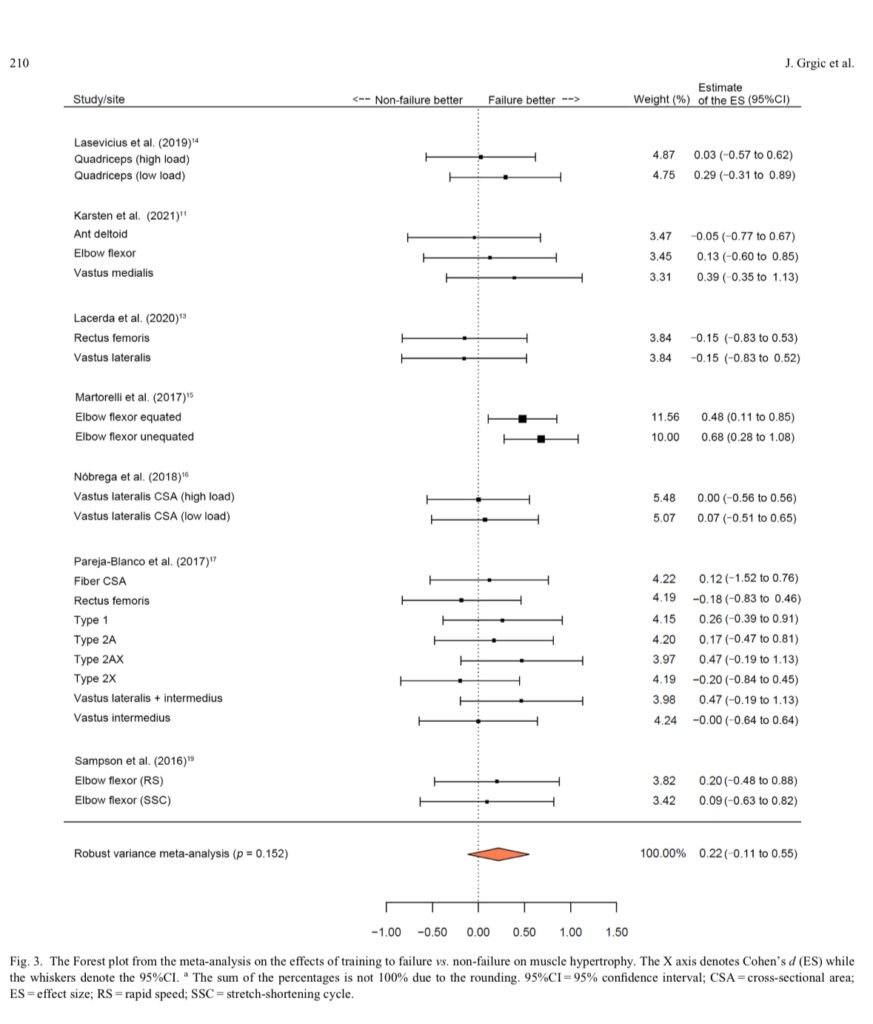
Image 1)
In the table above, we see a meta-analysis, which is simply the sum of results from different studies (the orange diamond is the final result).
Each dot with a little wings on each sides represents a study. For example, the one below in the image (Image 2) (red circle) represents the study by “Lasevicius, T.” This scientist from Brazil
🇧🇷 had a group of 25 handsome men train to failure and to non-failure.
The green dot represents the result. If the green dot is on the right, it means the group benefited from training to failure (failure better), and if it’s on the left, it means the group benefited from training to non-failure (non-failure better).
So, it seems that training to failure was better, right? But there’s still something to explain: the wings (in the blue circle) on the dots symbolize where the other 25 handsome Brazilians results were prevalent in the study. For example, “Neymar gained 5g of muscle when he trained to non-failure and 5g of muscle when he trained to failure.”
So for Neymar, training to failure was the “same” as not training to failure.
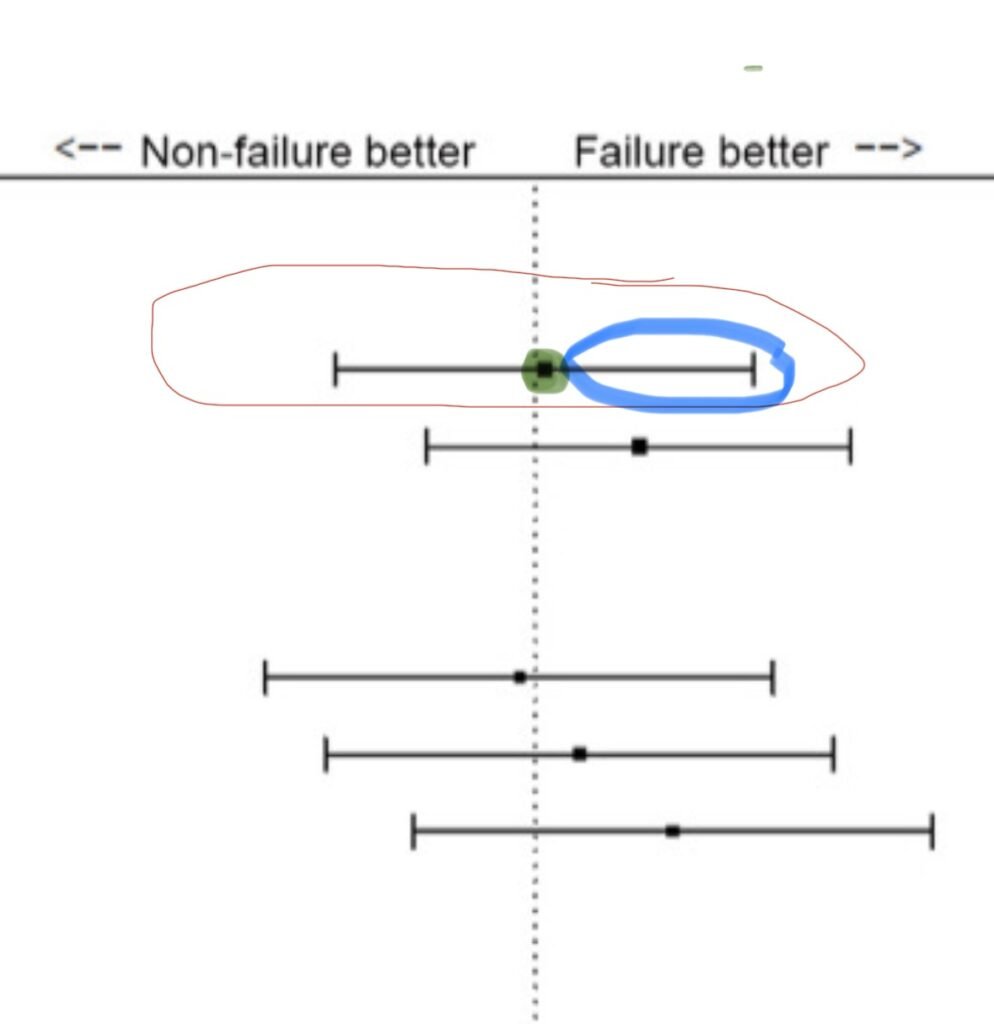
(image 2)
This is roughly how it would look:
5-5 = 0, meaning a difference of 0 (image 3)
This is how one of the 25 handsome Brazilians that Lasevicius studied would look.
There’s still a little more information needed to explain the wings gestures (image 2, blue circle), so let’s add two more people to understand them.
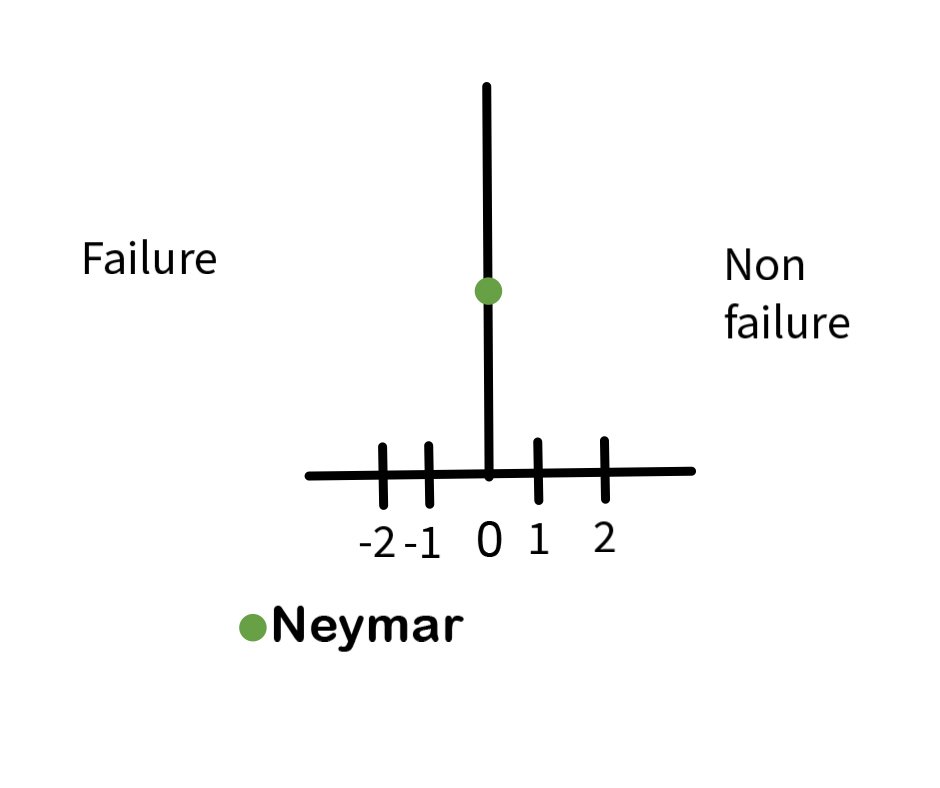
(Image 3)
Now we have “Gabriel” and “Ronaldinho.”
Gabriel gained 7g of muscle mass when he trained to non-failure and 9g of muscle mass when he trained to failure.
Gabriel: 7-9 = -2
Ronaldinho gained 11g of muscle mass when training to failure and 10g of muscle mass when training to failure.
Ronaldinho: 11-10 = 1
And on the graph it would look like this (Image 4)
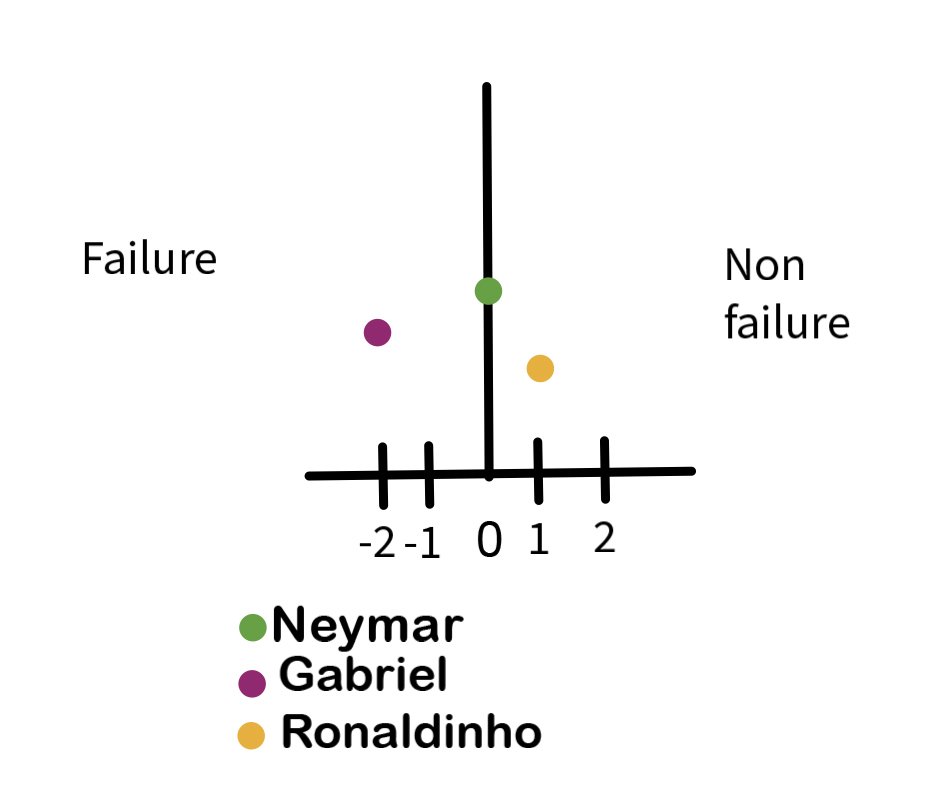
(Image 4)
Now we have enough information to describe the wings (Image 1). If we take an “average” of the results of Neymar, Gabriel, Amanda, and others, we get the big blue dot (average of all the data), and the wings symbolize that 95% of the data falls within the distance of the hands. (Image 5)
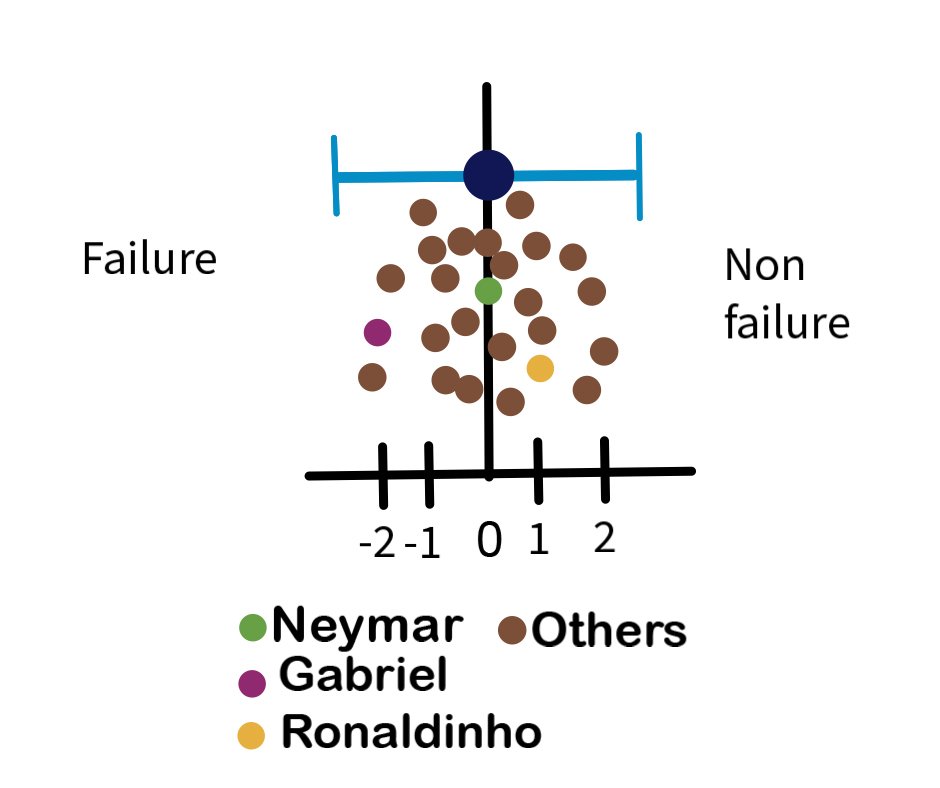
(Image 5)
And so, looking back at the meta-analysis results, we realize that the vast majority of the results are very close to the line where the difference is zero. Although there might be a slight tendency towards failure (orange diamond)(image 1). Considering the situation of most readers with an 8-hour workday or other daily commitments, I consider the sacrifice of going to failure on every set quite high, given the small possible extra gain.
However, if you feel you’re not progressing in a particular muscle, as a strategy to ensure you’re training intensely enough, you could go to failure on that specific exercise.
There’s a lot of interesting data in the study, such as the fact that highly trained subjects seem to have slightly better results. However, this study evaluated very few people, and even so, the recommendations I mentioned still seem very appropriate to me.
It’s a really good study and very interesting overall. I hope the information is helpful. Note: The explanation I gave for understanding the dots and wings in the meta-analysis didn’t use the statistical formulas they created; I simply used what I considered a simple example to explain their meaning. But although the explanation wasn’t exact in my opinion, I consider it correct.